The pickup truck world has long been divided by a massive, invisible wall. On one side, the United States dominates with its heavy-duty towing machines and luxury-laden cabin cruisers. On the other, the rest of the world relies on one legendary nameplate for everything from humanitarian missions to off-road expeditions: the Toyota Hilux.
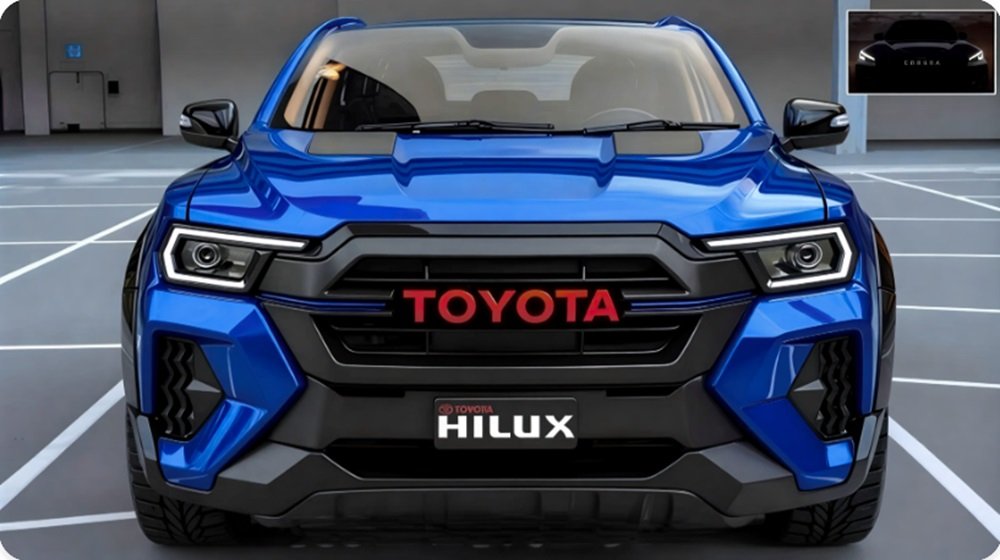
For years, American enthusiasts have looked across the ocean with envy, wondering why the “indestructible” truck that famously survived a building demolition on Top Gear wasn’t in their driveways. But as 2026 rolls around, the whispers of a $40,000 Hilux reaching American shores are growing louder, fueled by a midsize market that is suddenly hungry for something simpler, tougher, and significantly more affordable than the current domestic crop.
The Legend Reborn: What Makes the 2026 Hilux Different?
The 2026 Toyota Hilux isn’t just a carryover of the same truck that’s been serving global markets for decades. It marks the introduction of the ninth generation, a total overhaul designed to meet the rising standards of modern drivability without losing the “bulletproof” reputation that defined it.
Unlike the Toyota Tacoma—which has pivoted toward a refined, lifestyle-oriented experience for the US market—the 2026 Hilux remains a workhorse at its core. It features a high-tensile steel ladder-frame chassis that prioritizes torsional rigidity over highway plushness. In an era where many “midsize” trucks are becoming bloated and over-complicated, the Hilux’s focus on essential durability is its greatest selling point.
Why $40,000 is the Magic Number
In the current American truck market, “affordable” is a relative term. With the average price of a new full-size pickup hovering near $60,000, and even midsize trucks like the Chevy Colorado or Ford Ranger quickly climbing into the mid-$50,000s when equipped with 4WD, a $40,000 Hilux represents a seismic shift.
Toyota’s strategy for the 2026 model includes a “back-to-basics” approach for certain trims. By utilizing a simplified 48V mild-hybrid diesel or a high-efficiency 2.4L turbo gasoline engine, Toyota can keep manufacturing costs down. The target price point would place the Hilux directly in competition with base-model domestic trucks, but with a standard of reliability that American brands have struggled to maintain in recent years.
Performance: The 48V Hybrid Advantage
One of the most significant updates for 2026 is the 48V Mild-Hybrid System. This isn’t a Prius-style hybrid meant for silent electric cruising; it’s a performance-enhancing system designed for torque.
The system pairs a 2.8-liter turbo-diesel engine with a compact motor generator. This setup provides:
-
Enhanced Low-End Torque: Essential for crawling over rocks or pulling a heavy trailer from a standstill.
-
Improved Efficiency: A projected 5–10% improvement in fuel economy, which is vital for long-range overland travel.
-
Smoother Stop-Start: In urban traffic, the 48V system makes the diesel engine’s transitions nearly imperceptible.
For the American buyer, this offers a middle ground between the raw power of a V6 and the fuel-sipping nature of a compact SUV—all while maintaining a 7,700-lb (3,500 kg) towing capacity that rivals many larger vehicles.
Hilux vs. The Big Three: How It Compares
To understand why the Hilux is being hailed as a “US truck killer,” we have to look at the current leaders in the midsize segment.
The Ford Ranger
The Ranger is a tech-heavy powerhouse, especially in its Raptor trim. However, the Ranger has often been criticized for its “fussy” interior and complex electronics. The Hilux counters this with a cabin that is ruggedized. You’ll find physical knobs for the climate control and a simplified infotainment system that won’t require a software degree to operate while wearing work gloves.
The Chevrolet Colorado
The Colorado currently leads the class in ride quality thanks to its sophisticated suspension. However, the Hilux’s leaf-spring rear setup—while stiffer—is designed to handle a full payload for 20 years without sagging. For the buyer who views a truck as a tool rather than a toy, the Hilux’s “over-engineered” suspension is a feature, not a flaw.
The Internal Rivalry: Tacoma vs. Hilux
This is the most interesting matchup. The Tacoma is arguably the best-selling midsize truck in the US, but it has become increasingly expensive. Many enthusiasts argue that the Tacoma has “gone soft” to appeal to suburban commuters. The 2026 Hilux would serve as the “hardcore” alternative—the truck for the buyer who wants the Tacoma’s reliability but the Hilux’s global-standard toughness.
The “Indestructible” Factor
What really sets the Hilux apart from American-made trucks is its testing cycle. Toyota tests the Hilux in environments that most US trucks will never see: the Sahara Desert, the Australian Outback, and the high-altitude mines of the Andes.
The 2026 model maintains a 27.6-inch (700mm) wading depth and features a “Pitch and Bounce Control” system that keeps the chassis stable even when the terrain gets violent. In the US, where “off-road packages” often consist of little more than stickers and slightly better shocks, the Hilux’s inherent off-road geometry is a breath of fresh air.
Interior: Utility Meets 2026 Tech
Inside, the 2026 Hilux bridges the gap between a utilitarian workspace and a modern vehicle. The higher trims, such as the Invincible or Rogue, offer:
-
Dual 12.3-inch Screens: One for the driver’s instrument cluster and one for the central infotainment.
-
Soft-Touch Durability: Materials that look premium but are specifically chosen for their ability to be wiped down after a day in the mud.
-
Safety First: The Toyota Safety Sense 3.0 suite comes standard, offering adaptive cruise control, lane-keeping assist, and a pre-collision system that can detect pedestrians even in low-light conditions.
The Elephant in the Room: Will it Actually Hit the USA?
The “Chicken Tax”—a 25% tariff on light trucks imported to the US—has historically been the barrier keeping the Hilux out of America. However, industry analysts suggest two potential paths for the 2026 Hilux:
-
North American Production: Toyota could utilize its existing plants in Mexico or Texas to build a US-spec Hilux, bypassing the tariff entirely.
-
The “Tacoma Alternative” Branding: Toyota may position the Hilux as a specialized “commercial-grade” offering for small businesses and fleet buyers who are currently priced out of the luxury-truck market.
Final Thoughts: The Truck We Need
The 2026 Toyota Hilux represents a return to what a pickup truck was originally meant to be: a reliable, affordable, and nearly indestructible partner for work and play. While American trucks continue to chase higher horsepower figures and larger screens, the Hilux is chasing longevity.
If Toyota can truly deliver this truck to the US market for around $40,000, it won’t just be another option in the midsize segment—it will be a wake-up call to the entire industry.